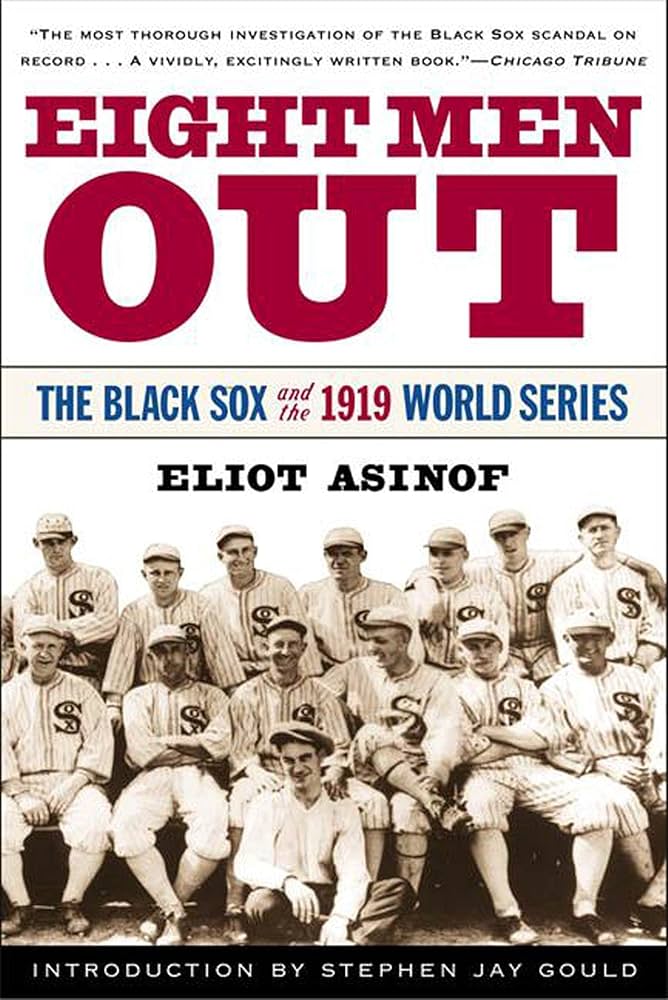
Eight Men Out was based on the book Eight Men Out: The Black Sox and the 1919 World Series written by Eliot Asinof. Asinof, who was not a historian by trade, was a minor-league baseball player and then worked as a television writer.[1] Asinof was approached to help write a drama based on the 1919 Black Sox scandal, but ultimately this show never aired. Asinof used the research that he did for the show to publish Eight Men Out. The book was published in 1963 and touted as the definitive history of the Black Sox scandal on release. The extensive research that Asinof uncovers depicts the series of events with great detail, discussing everyone involved with the fix. Asinof goes through the whole ordeal, describing everything from the lead-up to the fix and who was initially involved, to the media breaking the story and the trial of the players.[2] The movie Eight Men Out does an excellent job of adapting Asinof’s work to the silver screen, but there are still several missing facts and wrong details. This can be identified not so much as a problem of Sayles’ adaptation of Asinof’s book, but Asinof’s adaptation of the facts of the scandal. Asinof’s book has come under fire regarding the complete accuracy of the work that he did in more recent years, as he included neither footnotes nor a formal bibliography.[3] His lack of formal training as a scholar led him not to include references to where exactly he got his information, leaving tangible doubt in some of the contested sections of his book. This doubt has mostly carried itself to Sayles, as his adaptation is much more accessible and recent, leaving the potential missed facts by Asinof to fall onto Sayles.
1.) Daniel A. Nathan, Saying It’s So: A Cultural History of the Black Sox Scandal, (Champaign, University of Illinois Press, 2002), Accessed November 18, 2024, 106, https://ebookcentral.proquest.com/lib/umw/reader.action?docID=3414080&query=.
2.) Eliot Asinof, Eight Men out: The Black Sox and the 1919 World Series, 1st Owl Book ed (New York: H. Holt, 1987) 1-293.
3.) Nathan, Saying It’s So, 111-112.